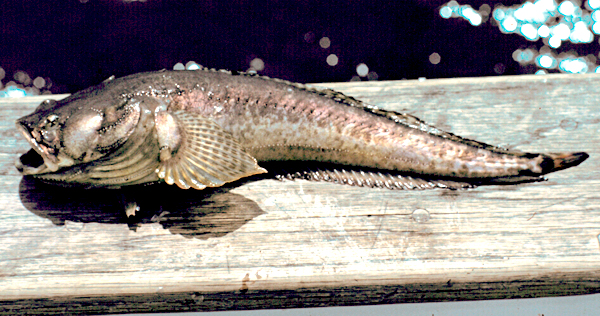
Specklefin Midshipman, Porichthys myriaster: The Specklefin Midshipman is the largest of the midshipmen, reaching 20 inches in length. It is a tan-brown color with a golden sheen and 9 to 11 dark saddles on the back. The margin of the anal fin is pigmented and the dorsal fin has 4 to 13 oblique dark bars. The margin of the caudal fin has a distinct dark band.
Keys to identification of the Specklefin Midshipman are that it has 36 or 37 anal rays, 38 or 39 dorsal rays, and 11 to 13 gill rakers on the lower arch.
This fish species is very similar to and can be easily confused with the Miminic Midshipman, Porichthys mineticus, and the Plainfin Midshipman, Porichtys notatus, both of which have lower anal and dorsal ray counts.
The Speckelfin Midshipman is found in the first 400 feet in the water column, over sandy and muddy bottoms, being common in bays. It is demersal, spending days half buried in the sand and becoming more active at night.
Due to its rarity the Specklefin Midshipman is deemed to be of limited economic value.
In Mexican fishing waters, the Specklefin Midshipman is found along the Pacific side of the Baja peninsula from the California boarder to Magdalena Bay.
The Specklefin Midshipman is a member of the Batrachoididae Family, which includes the toadfish, midshipmen, and monkfish which are known in Mexico as peces sapo.
These fish are characterized by large heads with eyes on top, two or three stout dorsal spines followed by a separate second dorsal fin with a long base, and anal fins without spines.
They are bottom dwellers found under rocks, in crevices, or buried in the sand. Eggs are attached to submerged debris. They are found in brackish coastal estuaries as well as in waters to depths of 1,000 feet. They consume crabs, echinoderms, fish, mollusks, and shrimp.
The Midshipmen have four lateral lines, light-producing organs known as photophores, and anal and dorsal fins that are not continuous with the caudal fin. There are 14 global members of the Porichthys Genus, of which four are found in Mexican waters.
The midshipman fishes are the genus Porichthys of toadfishes. They are distinguished by having photophores (utilized to attract prey) and four lateral lines. They are nocturnal and bury themselves in the sand or mud bottoms of the intertidal zone during the day and at night float just above the sea bed. Some species contain venomous dorsal spines and are capable of inflicting serious injuries. Mating in midshipman fishes depends on auditory communication. Males during the breeding season broadcast a sound usually described as a hum, generated by rapid contractions of the muscles in the swim bladder. The sound can be sustained for up to an hour and is loud enough to be heard by (and to puzzle) people on nearby land and boats; the hulls of boats tend to amplify the sound to sleep-disrupting levels. Reproductive females develop a selective sensitivity to this sound and respond by laying eggs in the rock nest of a singing male.

Specklefin Midshipman, Porichthys myriaster: Caught during fishing by George Bogen in Santa Monica Bay, California, June 16, 1985, aboard the boat Happy Man out of Marina del Rey Sportfishing, in 100 feet of water, on a live anchovy, water temperature approximately 64 degrees, about 14 inches long. The fish was copper colored, with a beige bottom. Identification courtesy of H.J. Walker, Jr., Scripps Institute of Oceanography, La Jolla, CA. Description courtesy of John Snow. Photo courtesy of George Bogen.
Mexico Fishing Home Page < Fish Photo List < Specklefin Midshipman
Copyright ©