Nurse Shark Photos and Species Information for Fish Caught in Mexico
See current, on-the-spot sportfishing reports and photographs of fish caught at Mexico's top vacation spots in this week's edition of
"Mexico Fishing News" and see hundreds of other fish pictures and species information by clicking here for our main Fish Photo List.


Nurse Shark Logo

Nurse Shark
Gata Nodriza
(Ginglymostoma cirratum)

Fish Identification Photos: Nurse Shark, Ginglymostoma cirratum: The Nurse Shark is a member of the Orectolobidae Family and the sole member of the Ginglymostoma Genus. It is named for the sucking sound it makes while ingesting food, which is similar to the sound of a nursing baby. The Nurse Shark is a large, sluggish bottom-dweller that is considered harmless to humans unless provoked.

The Nurse Shark has a stout body and strong jaws. It is brown or dark grey-brown in color with the juveniles having spots. The skin, unlike most sharks, is smooth to the touch. The Nurse Shark has a broad, flat head with a pair of barbells, used to seek out food buried on the ocean floor, that extend from the snout. It has small oval eyes and the mouth is equipped with thousands of teeth which are often lost when feeding on shells and coral and then quickly replaced with new teeth. Helping in the identification of this species, the Nurse Shark has 5 gill slits, with the fourth and fifth over the pectoral fins and very close together. The base of the first rounded dorsal fin originates over the pelvic fins; the second dorsal fin is one-half the size of the first dorsal fin. Behind each eye is a unique siphon device, a spiracle, which takes in water for breathing when the shark is at rest on the ocean floor. The tail is moderately long, approximately one-third of the total body length, but it is asymmetric with a poorly developed lower half.

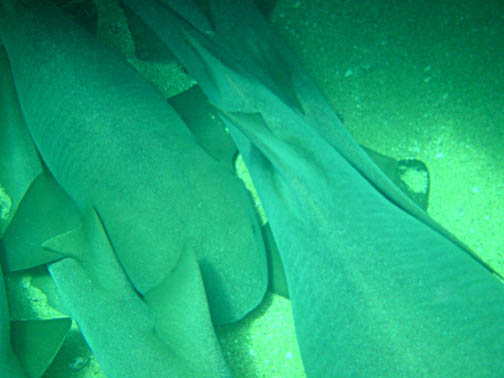
The Nurse Shark ranges in size from 2 to 13 feet. It is most likely to be confused with the Lemon Shark, Negaprion breviostris (more robust body, yellow-brown coloration with two large dorsal fins). The Nurse Shark is a shallow-water inshore species found near sandy beaches, mudflats, sandbars, and coral reefs, from the tidal line up to 300 feet deep in the water column. It congregates in schools and is sluggish, resting on the ocean floor during the day, often piled together. It is a nocturnal hunter, consuming bottom-dwelling crabs, fish, lobsters, octopus, sea snails, shrimp, squid, urchins, and coral. The babies hatch within the body of the mother and litters vary in size from 20 to 30 pups. They reach maturity in 15 years.

In Mexico the Nurse Shark is found from Magdalena Bay south along the Pacific side of Baja California, throughout the Sea of Cortez, and along the mainland south to Guatemala; it appears to be absent from around the oceanic islands. The Nurse Shark is a non-migratory species and with lower water temperatures they become very lethargic.

Nurse Shark Photo 1

Nurse Shark Cluster: Pepe Murrieta of Pepe's Dive Service, East Cape, Baja California, Mexico, reported seeing groups of ten, 12-foot nurse sharks at Cabo Pulmo, in August 2003: "They're huge!" Photo courtesy Pepe Murrieta.

MEXICO FISHING NEWS  <  FISH PHOTO LIST  <  NURSE SHARK