Mexican Hogfish
Vieja, Vieja Mexicana, Vieja de Piedra
(Bodianus diplotaenia)

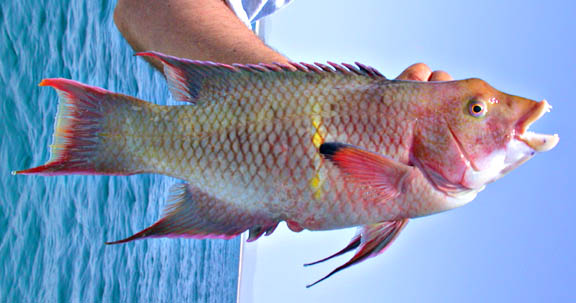
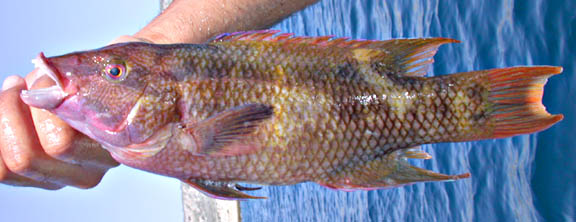
Mexican Hogfish, Bodianus diplotaenia: The Mexican Hogfish is very easy to identify once it is understood that it comes in a vast range of colors (see photos), and also that it changes sex from female to male, growing a bump on its forehead in the process (see first two photos below).

Individual specimens have strikingly variable color patterns in juveniles compared to adults, and males compared to females. The distinctly male phase, with the pronounced hump on the forehead, and might be confused with the California Sheephead, Semicossypus pulcher. Some specimens have two distinctive, dark, interrupted stripes running from eye to tail (see fourth photo below). The Mexican Hogfish has protruding canine teeth, large cycloid scales, and only eleven or twelve branched caudal rays in its soft, wavy tail.

The Mexican Hogfish is a member of the Labridae or Wrasse Family known for its brilliant colors. The Mexican Hogfish is solitary and not found in schools. It feeds mainly during daylight hours. At night, juveniles secrete a mucous cocoon that envelops the fish while it sleeps. The Mexican Hogfish eats small crustaceans, polychaetes and mollusks.

This fish species reaches a length of about 30 inches and weights up to about 20 pounds. It is normally found over rocky shorelines, within the first 50 feet of the water column, but it is known to inhabit water as deep as 250 feet.

Distribution in Mexico fishing areas

In Mexican fishing waters , the Mexican Hogfish is found in all waters south of Laguna San Ignacio on the Pacific side of the Baja California peninsula, throughout the Sea of Cortez, all along mainland, and around all oceanic islands. It is viewed by locals as poor table fare and normally a “catch and release.”

Mexican Hogfish picture 1

Mexican Hogfish picture 2

Mexican Hogfish picture 3

Mexican Hogfish picture 4

Mexican Hogfish, Bodianus diplotaenia: These fish were caught while fishing with Capt. Pata in the panga Salome, at La Playita, San Jose del Cabo, Baja California Sur., Mexico, in 84-degree water, midmorning in November 2002, in 50 to 100-foot deep water, utilizing a 30-pound test, with a 40-pound two-dropper loop rig, with swivel, 3-ounce bank sinker, and Mustad 92553 hooks, size 2/0, with a live sardina, 10 miles south of La Playita. Size approximately 14 inches and 1 pound. Viewed by locals as a soup component or as a “catch and release” depending on what’s in the fish box at the time of the catch. This species is also accessible from the shore by fishing the bottom with cut bait, but be prepared for a battle, especially around structure. The male has a bump on its head. The Mexican Hogfish comes in a variety of colors, ranging from bright red to a deep purple, and various mixtures thereof. Description and photos courtesy John Snow; fish identification courtesy Dr. Milton Love, University of California, Santa Barbara.

Mexican Hogfish picture 5

Mexican Hogfish picture 6

Mexican Hogfish, Bodianus diplotaenia: Caught while fishing at this location, at Km. 14 (Twin Dolphins), San Jose del Cabo, B.C.S., Mexico, early September 2003, near sunset, one hour fishing. Description and photo courtesy John Snow.

Mexican Hogfish picture 7

Mexican Hogfish picture 8

Mexican Hogfish, Bodianus diplotaenia: Caught during a fishing trip at Las Arenas, La Paz, Baja California Sur, Mexico, from a panga, in 40-foot deep water, about one mile north of the Punta las Arenas lighthouse. Description and photos courtesy Gene Kira.

Mexican Hogfish picture 9

Mexican Hogfish, Bodianus diplotaenia: Description courtesy of John Snow.

Mexico Fishing Home Page < Fish Photo List < Mexican Hogfish