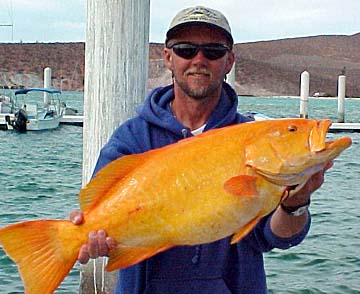
Leopard Grouper, Mycteroperca rosacea: The Leopard Grouper (spotted phase) and the Golden Grouper (golden phase) are two spectacularly-different color variations of the same fish species.
The Leopard Grouper is characterized by its uniform, non-ragged tail margin and a head, body, and fins are covered with small red-brown dots over a grey-brown background. The fins have very narrow white margins. When alive, the Leopard Grouper's mottled background tends to form irregular, interconnected bars down its sides. After death, these fade away, leaving the field of spots.
Approximately 1 percent of Leopard Groupers exhibit the Golden Phase, and are called Golden Grouper, or sometimes Golden Cabrilla, an easy fish to identify due to its spectacular, overall orange color.
The Leopard Grouper reaches about three-feet in length and up to about 40 pounds. The Spotted Phase can be confused with the Spotted Cabrilla, Epinephelus analogus, although the Spotted Cabrilla has a rounded anal fin, while the Leopard Grouper has a pointed anal fin. The Leopard Grouper, Golden Grouper, lives in relatively shallow water up to 150 feet in depth with rocky bottoms and close to shore. It is most active just after dark, but also throughout the day, often feeding on Flatiron Herring (for which they are sometimes called "Sardinera") but also on almost any type of prey smaller than itself.
In Mexican fishing waters , the Leopard Grouper or Golden Grouper are found in all areas south of Magdalena Bay, all around the Sea of Cortez, and on the mainland to Guatemala. It is considered an excellent food fish and is sold commercially. It is the bread and butter food fish of the Sea of Cortez.
The Leopard Grouper, Golden Grouper is one of the Serrandae or Sea Bass and Grouper Family.

Leopard Grouper, Mycteroperca rosacea: Photo courtesy John Snow.


Leopard Grouper, Spotted and Golden Phases, Mycteroperca rosacea: The upper photo is of a spotted phase Leopard Grouper caught while fishing with Captain Pata in the panga Salome, La Playita, San Jose del Cabo, Baja California Sur, Mexico, midmorning in May 2003, in 77-degree water, 100 to 200-foot deep water, utilizing 60-pound test and size 7/0 hook baited with a live mullet, trolled on the surface, 20 miles north of La Playita. Size approximately 3 feet and 30 pounds and that required about a 10-minute tug-of-war to land of which the first 5 seconds is critical.
The second picture is of a golden phase Leopard Grouper, or Golden Grouper, caught at the same time in the same location via the same technique. Viewed by locals as a prized catch and as excellent table fare. Descriptions and photos courtesy John Snow.

Leopard Grouper, Spotted and Golden Phases, Mycteroperca rosacea: Photo courtesy John Snow.

Golden Grouper, Mycteroperca rosacea: Golden phase Leopard Grouper caught during a fishing trip near La Paz, Baja California Sur, Mexico, by Phil Desautels, April 2000. Courtesy Jonathan Roldan Fishing Services. About 1-2 percent of the normally olive-brown leopard groupers change to this bright orange color. Photo courtesy Jonathan Roldan.
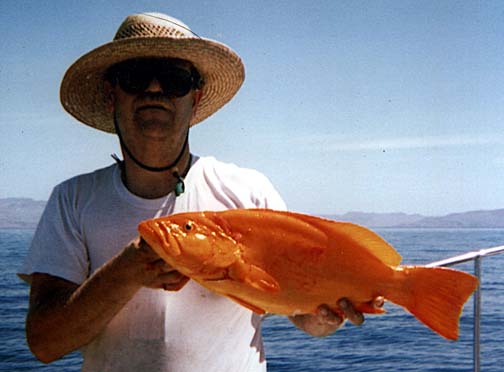
Golden Grouper, Mycteroperca rosacea: Don Naslund with a golden phase Leopard Grouper, or Golden Grouper caught in the Midriff Area, Sea of Cortez, Baja California, Mexico. Photo courtesy Don Naslund.
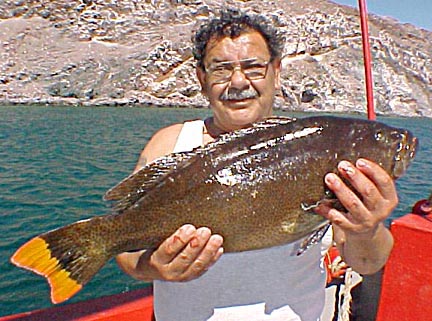
Golden Grouper, Mycteroperca rosacea: Bob Castellon with a Leopard Grouper showing an incomplete color phase change. Photo courtesy Gene Kira.
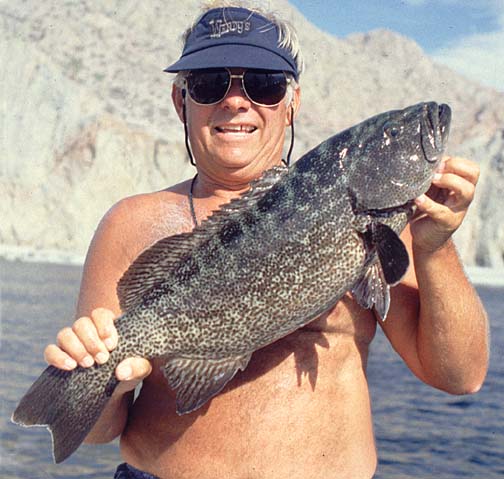
Leopard Grouper, Mycteroperca rosacea: Vagabundos del Mar President, Tony Schuck, with leopard grouper caugh while fishing t at the south end of Isla San Lorenzo, Sea of Cortez Midriff Islands, Baja California, Mexico. Photo courtesy Gene Kira.
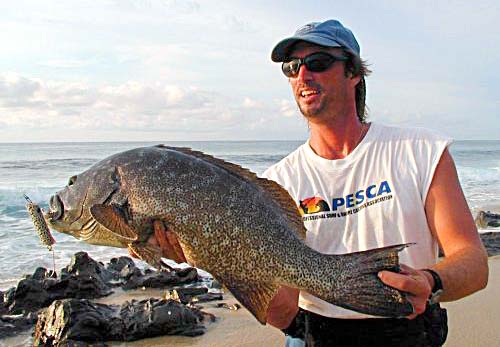
Leopard Grouper, Mycteroperca rosacea: Jeff Klassen with a beauty caught from the surf at Cabo San Lucas, Baja California Sur, Mexico. Photo courtesy Jeff Klassen.
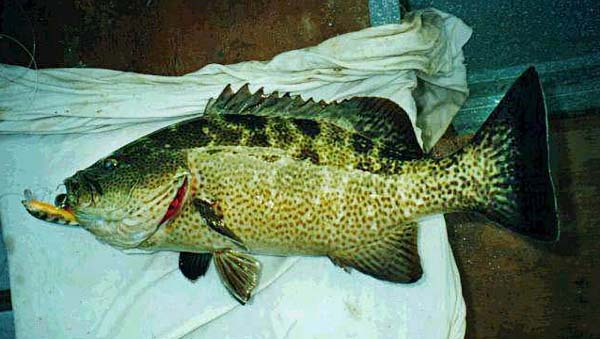
Leopard Grouper, Mycteroperca rosacea: Caught during fishing at Punta Colorada, East Cape, Baja California Sur, Mexico, June 1999, length 26 inches, on a Rapala with 12-pound line, from a panga. Photo courtesy Peter Langstraat.
Mexico Fishing Home Page < Fish Photo List < Leopard Grouper or Golden Grouper
Copyright ©