Great White Shark, Carcharodon carcharias: The Great White Shark is a member of the Lamnidae Family and is at the apex as a mega-predator. It is at the top of the food chain with no natural predators. Unfortunately, due to its formidable nature, very little is known about its lifestyle.
The earliest reports of the Great White Shark are attributed to Aristotle. As a subject of Greek mythology, the Great White Shark was given an image that it still retains: a little known, rarely seen, and greatly feared monster from the sea.
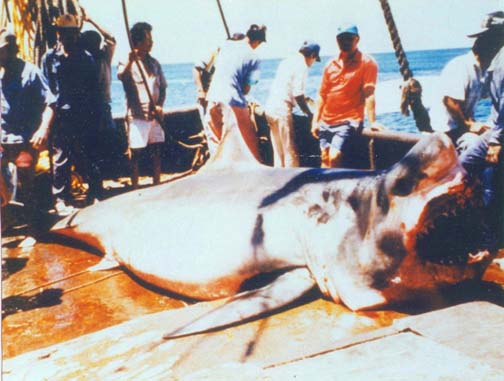
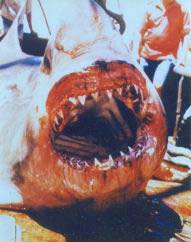
The Great White Shark reaches lengths of up to 21 feet and 5,000 pounds. It normally averages only 10 to 15 feet in length, but can have a mouth that is four feet wide. Females are much larger than males. The Great White Shark varies in color from black to slate-gray above, with the ventral surfaces being predominately white. The ventral tips of the pectorals are black and there is a black oval blotch at the base of the pectoral fins. The snout is conical, blunt, and dorsally flattened. The mouth has a set of large, triangular, coarsely serrated teeth.
This fish species has five large gill slits. The first dorsal fin is an equilateral triangle in shape with a slightly concave rear margin; its origin is slightly anterior to the inner corner of the large pectoral fin. The second dorsal fin is minute with its posterior margin slightly ahead of the origin of the equally minute anal fin. The lunar-shaped, concave caudal fin with lobes being of equal size is also an identifying characteristic. The Great White Shark maintains a body temperatures about 14 degrees Centigrade above the surrounding sea temperature. Litter sizes have been verified from 5 to 10 with young born at 4 to 5 feet in length. It is believed that each female reproduces biennially. The best estimate of life span is in excess of 20 years.
The Great White Shark is equipped with two of the most powerful sensing mechanisms in nature: a highly developed sense of smell and the ability to sense the electrical fields emitted from all living creatures. This allows the Great White Shark to quickly detect a wounded or bleeding and incapacitated animal, which provides it with easy prey. Seals and sea lions are favorite prey of the Great White Shark. It also feeds on dolphins and the carcasses of large whales. The Great White Shark attacks its prey from below utilizing a 45-degree angle to maximize surprise. The Great White Shark lives a solitary life and is highly migratory, roaming the seas of the globe. However, if food is abundant, it will stay in one location for extended periods of time. It is found from the surf line to well offshore, at the surface, and in depths up to 750 feet, commonly patrolling small coastal archipelagos inhabited by seals and sea lions, rocky headlands where deepwater is adjacent, and offshore reefs, banks and shoals. The Great White Shark travels as a slow graceful cruiser, either just under the surface or just above the bottom, at speeds of approximately 2 m.p.h. It is capable of making short high-speed runs, which include repeated breaches.
The Great White Shark is found in all temperate seas of the globe, including all Mexican fishing waters, in water between 7 and 26 degrees Centigrade, but much more commonly in water between 13 and 20 degrees Centigrade. The number of Great White Sharks that inhabit the globe is presently unknown. Globally, from a conservation perspective, the Great White Shark is classified as "vulnerable." Predators such as the Great White Shark are an integral part of the ecosystem. The Great White Shark is primarily exploited by the curio trade, with a pair of jaws fetching between $10,000 and $50,000, and as stuffed trophies for wall mounting.
Due to its rarity it is a limited target of the recreational angler, but it is collected as a by-product by longliners and netters. The fins of the Great White Shark are sold to the Asian soup market and the meat is sold commercially for food. The Great White Shark also suffers from entrapment by anti-shark beach netting installed to ensure the safety of bathers at selected beaches. It is also subject to harassment by cage diving, conducted in some parts of the world by inexperienced individuals. Cage diving has been outlawed in California. As the Great White Shark is a nomadic global traveler, the loss or degradation of habitat is not considered to be a problem at present.


Great White Shark, Carcharodon carcharias: From Vince Radice of the Sonoran Sport Center in San Carlos, Sonora, Mexico, these photos of a great white shark estimated to weigh over a ton, which was caught during fishing by commercial fishermen in a trawling net near Isla San Pedro Martir, Sea of Cortez, Mexico. Said Radice, "I use it in my shop to show people when they ask if there are any sharks in the Sea of Cortez." Photos courtesy of Vince Radice.
Mexico Fishing Home Page < Fish Photo List < Great White Shark
Copyright ©