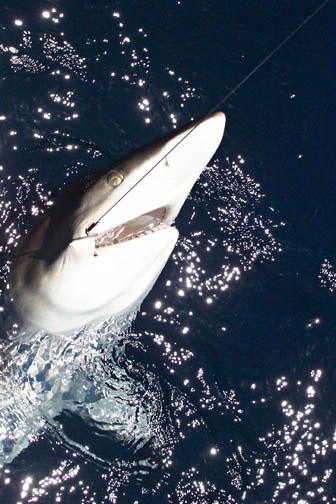
Blacktip Shark
Tiburón Macuira
(Carcharhinus limbatus)

Blacktip Shark, Carcharhinus limbatus: The Blacktip Shark has a grey-brown coloration dorsally, shading to white ventrally; a small grey line runs horizontally along the side. All of the fins have black tips, with emphasis to the first dorsal, the lower lobe of the caudal fin, and the pectoral, and pelvic fins. The first dorsal fin of the Blacktip Shark originates just before the end of the pectoral fin base, and the second dorsal fin originates slightly before the anal fin. There is no ridge between the dorsal fins.

The Blacktip Shark is similar in appearance to the Bignose Shark, Carcharhinus altimus, the Copper Shark, Carcharhinus brachyourus, the Galapagos Shark, Carcharhinus galapagensis, and the Dusky Shark, Carcharhinus obscurus, but none of the above has all the fins trimmed in black.

This fish species can reach a maximum of 9 feet in length; the babies at birth are 15 to 28 inches in length. The Blacktip Shark is an inshore pelagic species found in shallow inlets, bays, and lagoons, at depths up to 100 feet.

Distribution in Mexico fishing areas

The Blacktip Shark has a broad distribution and is found in all Mexican fishing waters; however, it appears to be less abundant between Guerrero Negro and Magdalena Bay on the Pacific side of Mexico's Baja California peninsula.

The Blacktip Shark is a member of the Carcharhinidae Family which consists of 50 species from 12 genera globally, of which 17 species from 7 genera are found in the Eastern Tropical Pacific.

Members of the Carcharhinus Genus or Requiem Sharks, of which there are 30 species globally of which 12 are found in the Eastern Tropical Pacific, are characterized by wide, blunt overhanging snouts, round eyes, 5 gill slits (the last 2 of which originate over the pectoral fin base), two dorsal fins with the first being much larger than the second but smaller than the caudal fin, and an asymmetric tail.

They are voracious predators, feeding on fish, sharks, rays, octopus, crabs, lobsters, and shrimp. They give birth to live young, with litters ranging from 1 or 2, to 35 pups, which are capable of immediately fending for themselves.

Blacktip Shark fish picture 1

Blacktip Shark, Carcharhinus limbatus: Caught while fishing in August 2005, at the mouth of the river, San Jose Del Cabo, Baja California Sur, Mexico, utilizing a live fly-lined small mullet. Size approximately 3.5 feet, 20 pounds. Description and photo courtesy John Snow.

Blacktip Shark fish picture 2

Blacktip Shark fish picture 3

Blacktip Shark fish picture 4

Blacktip Shark fish picture 5

Blacktip Shark, Carcharhinus limbatus: One of 11 juveniles removed from an 80 kilo, 8.5-foot mother brought back to the beach by the commercial fishermen of the greater Los Cabos area. Size is 42 cm. Photos courtesy of John Snow.

Blacktip Shark fish picture 6

Probable Blacktip Shark, Carcharhinus limbatus: Craige Harvey of El Centro fished at Puertecitos, Baja California, Mexico with Erik McElvany on McElvany's 22-foot boat, Ronda B, and got broken off 5 times on 60-pound line and 80-pound wire before they landed this 80-pound shark, August 2003. Photo courtesy Craige Harvey. (Tentatively identified as a Blacktip Shark by Fats Maloy: "There is a fishery for the species in the gulf, where they are somewhat common, and reputed to be tough fighters." Photo courtesy of Craige Harvey.

Mexico Fishing Home Page < Fish Photo List < Blacktip Shark