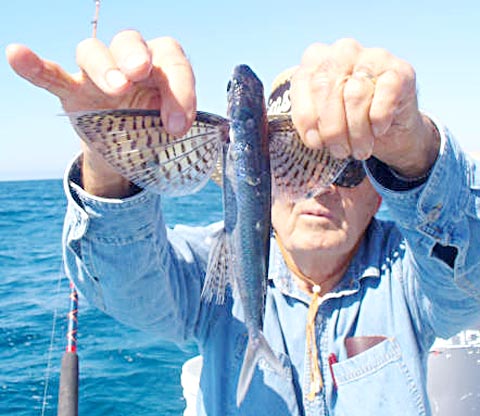
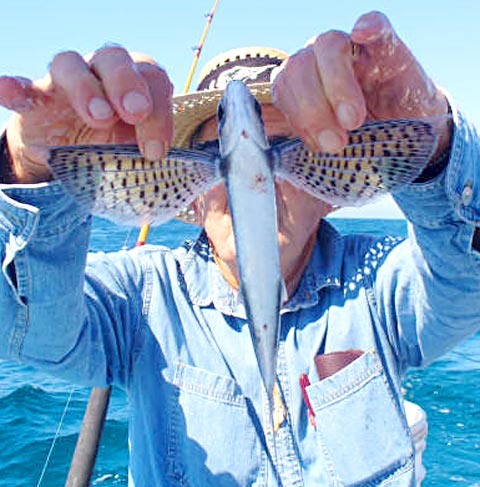
Beautyfin Flyingfish, Cypselurus callopterus: The Beautyfin Flyingfish is easy to identify and is not easily confused with other species due to the unique striping of its wings. The Beautyfin Flyingfish is dark blue to blue-black in color dorsally and silvery below. It has a very short snout than is shorter than the eye diameter.
The pectoral “wings” and pelvic fins of the Beautyfin Flyingfish are yellowish with numerous black spots which appear as black stripes. The anal and dorsal fins are pale grey. The caudal fin is dark grey. The pectoral fins are also short being 65 to 70 percent of standard length. The pelvic fins are long reaching beyond the middle of the anal fin. They originate nearer the anal origin than the pectoral base. The origin of the anal fin is below the middle of the dorsal fin.
The Beautyfin Flyingfish is a pelagic species found in surface waters, normally far out at sea. It is reported to reach a length of 11 inches. Due to its rarity, it is of limited value and interest to most.
In Mexican fishing waters it is found from Magdalena Bay south along the Pacific Coast of the Baja California peninsula, in the lower 50 percent of the Sea of Cortez, and along the coast of the Mexican mainland south to Guatemala.
Note: Flyingfish are very elusive and quality scientific photographs of most species are not yet available. We are aware of 15 different species of flyingfishes living in Mexican waters and would be most appreciative of receiving photographs of any collected flyingfishes.
The Beautyfin Flyingfish is a member of the Exocoetidae Family known in Mexico as voladores. Flyingfish are a global, pelagic species, normally found some distance out at sea. They have exceedingly long and wide pectoral fins which they use like wings, holding them rigid in place, allowing flights up to 300 meters, without a flapping motion. When swimming, these fins are held tight against the body. The fins have no spines. The lateral line is low on the body. The pelvic fin origin is closer to the anal fin origin than to the pectoral fin base. The anal fin origin is directly under the third dorsal ray. Flyingfish have deeply forked tails with the lower lobe larger than the upper. They feed on planktonic organisms. They generate large, sticky eggs that attach themselves to floating debris. Globally, there are 65 species of flyingfish from nine genera of which 15 live in Mexican waters. There are eleven global members of the Cypselurus Genus, of which two are found in Mexican waters.


Beautyfin Flyingfish, Cypselurus callopterus: Collected while fishing at Cabo San Lucas, Mexico , November 2007, after it flew aboard the charter sportfishing panga Cheer's. Photo courtesy of Ramon Druck.
Mexico Fishing Home Page < Fish Photo List < Beautyfin Flyingfish
Copyright ©