|
|

Longfin Halfbeak, Jumping Halfbeak
Agujeta Pajarito, Saltador Pajarito
(Hemiramphus saltator)
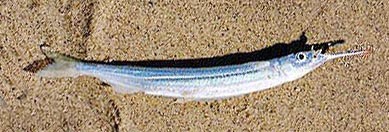
Fish Identification Photos: Longfin Halfbeak, Hemirampuhus saltador: The Longfin Halfbeak has an overall very silvery appearance, with a blue-black back, silver head and flank, and a white underside. It has transparent fins with the exception of the caudal fin which is dusky. The beak of the Longfin Halfbeak is relatively short being from 20 to 22 percent of its body length; its lower jaw is black with a red or orange tip.
The Longfin Halfbeak is characterized by a ridge before the eyes, 10-13 anal fin rays, a deeply forked caudal fin with larger lower lobe, and an unscaled snout. It has long pectoral fins that reach beyond the nasal opening when folded forward. The pelvic fins are quite short and found well toward the rear of the body.
The Longfin Halfbeak can be easily confused with four other halfbeaks: the Choelo Halfbeak, Hyporhamphus gilli (short beak with a red tip with the distance from the pelvic fins to the caudal fin being greater than the distance from the pelvic fins to the eye pupil); the Naos Halfbeak, Hyporhamphus naos (long beak with a red fleshy tip with the anal fin origin being directly under the dorsal fin origin); the Ribbon Halfbeak, Euleptorhamphus viridis (long slender body with disproportionate large anal, dorsal and pectoral fins); and the Silverstripe Halfbeak, Hyporhamphus unifasciatus (distance from eye to origin of anal fin equal to distance from anal fin to base of caudal fin).
The Longfin Halfbeak is a coastal pelagic species that reaches a maximum length of 22 inches. It can often be observed "fleeing for its life" as it is chased by large inshore predators. It produces large eggs that contain a sticky substance that allows them to attach to floating debris and travel the seas. The Longfin Halfbeak is found in all Mexican waters of the Pacific Ocean.
The Longfin Halfbeak is a member of the Hemiramphidae Family which includes the genus Hemiramphus, the halfbeaks, and close relatives of the flying fishes. Halfbeaks are found globally in all tropical and temperate seas. They are elongated silver fishes with lower jaws that extend into a long beak. The short upper jaw is triangular in shape and covered with scales; there is a ridge before the eyes. Halfbeaks have anal fins with 14 to 17 rays and dorsal fins at the rear of the body that are opposite each other. The pelvic fins are under the abdomen. The pectoral fins are high on the sides, the caudal fin is concave or slightly forked with the lower lobe longer, and the lateral line is low on the body. The halfbeaks are a surface large-school species and feed on seaweed, fish larvae, zooplankton, crustaceans, and other small invertebrates. Halfbeaks are sought after by large predatory fishes. In some parts of the world they are utilized as a food fish. There are 10 species from the genus Hemiramphus known globally.
|
Longfin Halfbeak, Hemirampuhus saltador: The first pictured fish, 19 inches in length, was perhaps the most interesting collection of any species I have found in Los Cabos waters. It appeared within three feet of me about six feet from the water line while I was surf fishing in February 2004. I simply picked it up and then noticed a 25-pound Dorado waiting patiently in the adjacent shallow water for his dinner to flop itself back into the water. Second fish pictured shows up on very rare occasions when one purchases a “scoop of bait.” Caught in the surf zone, La Playita, during April 2005, water temperature of 70 degrees, early morning in 5 to 10 foot water utilizing a cast net by Panguero bait salesmen. Size approximately 7 inches. Identification courtesy of H.J. Walker, Jr., Scripps Institute of Oceanography, La Jolla, Ca. Description and photos courtesy of John Snow.

Longfin Halfbeak, Hemirampuhus saltador: Caught on the fly by Dutch angler Ton van Dalen, East Cape, Baja California Sur, Mexico. Photo and fish identification courtesy Peter Langstraat.
|
|