Cow Cod, Cow Rockfish, Pacific Red Snapper, Oregon Red Snapper
Rocote Vaquilla
(Sebastes levis)
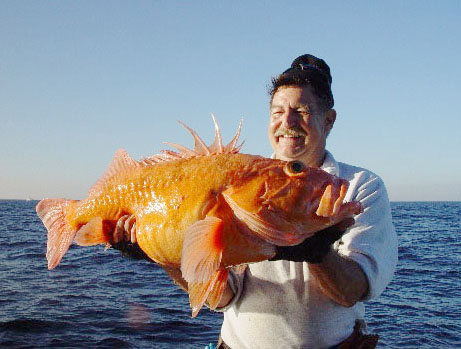
Fish Identification Photos: Cow Cod, Sebastes levis: The Cow Cod is a deep water, slow moving non-migratory species that is a voracious predator making it a “sitting duck” for anglers.
The Cow Cod has a deep compressed body that is a uniform pale pink to orange color, large head with five to six pairs of head spines, long distance between the eyes and edge of the mouth, a deeply incised deeply notched continuous dorsal fin in which the spines are longer than the rays, and a slightly forked caudal fin.
The Cow Cod is an easy species to identify due to its large head with spines, deeply notched dorsal fin, and long distance between its eyes and the edge of the mouth. However, the Cow Cod is somewhat similar to the Yelloweye Rockfish, Sebastes ruberrimus (yellow eyes and the edges of the anal caudal and pelvic fins are black).
The Cow Cod reaches 37 inches in length and just over 28 pounds in weight. It is a highly prized game fish, especially in Southern California. However, the catch rates are low. In some areas the Cow Cod is considered to be an endangered species, and unfortunately practicing “catch-and-release” is not an option because landed fish cannot be returned successfully to the deep. They are also slow growing with ages up to 55 years being documented. The Cow Cod feeds on small fishes, octopuses and squid. Each female lays two-million eggs per annum. The Cow Cod has been reported to possess mild venomous spines in its anal and dorsal fins.
The Cow Cod is one of the larger members of the Scorpaenidae or Rockcod, Rockfish and Rosefish Family. It is normally found between 480 and 1,200 feet deep in the water column over rocky reefs adjacent to large drop-offs. It has a limited distribution in Mexican waters being limited to the first 250 miles of the Pacific side of the Baja California peninsula, with fish taken as far south as Isla de Guadalupe. The Cow Cod is viewed as excellent table faire.
|
Cow Cod, Sebastes levis: Caught at the Coronado Islands, north of Ensenada, Baja California, Mexico, December 2002. Photo courtesy Werner Hradecky.
|